Hubert Baniecki and Michal Nauman awarded with the 2026 Witold Lipski Prizes in applied computer science
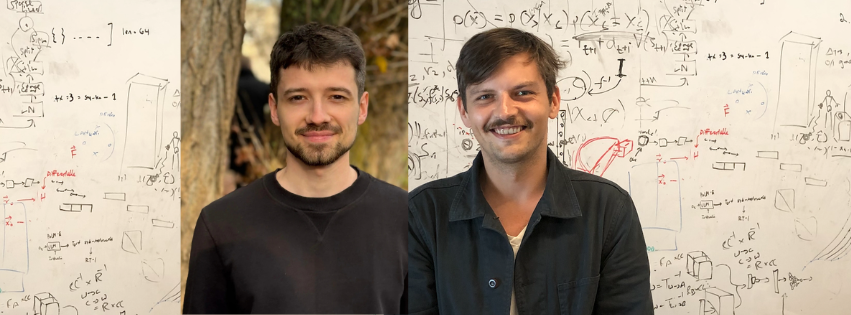
WARSAW, Poland — Young researchers Hubert Baniecki and Michał Nauman have been awarded equally the 2026 Witold Lipski Prizes in applied computer science – as part of the competition organized by IDEAS NCBR, a research and development center focused on artificial intelligence, and funded by the Kosciuszko Foundation. The two researchers were recognized for their contributions to explainable artificial intelligence and reinforcement learning.
The two researchers will each receive PLN 25,000. An honorable mention, without a monetary award, was given to Dr. Eng. Kamil Deja. No prize was awarded this year in the theoretical computer science category.
“This year, the Witold Lipski Prize was awarded for the twenty-second time,” said Dr. Grażyna Żebrowska, who has coordinated the prize since 2024 and is director for international cooperation at IDEAS NCBR. She said the high level of the submissions made the selection process particularly challenging and noted that most candidates worked in applied computer science, reflecting the growing role of artificial intelligence in contemporary research.
Researching how AI makes decisions
Hubert Baniecki, a PhD student at the University of Warsaw’s Faculty of Mathematics, Informatics and Mechanics and a research assistant at the Center for Trustworthy Artificial Intelligence at Warsaw University of Technology, works on explainable AI — methods designed to make the behavior of machine-learning models easier to understand.
His research addresses how predictive models, including deep neural networks, arrive at their conclusions. A particular focus is the development of efficient techniques for generating explanations and applying them in areas such as medicine.
In medical applications, for example, explainable AI can help researchers examine whether a model is associating patient test results with disease risk in ways that are consistent with established medical knowledge. Baniecki’s work also explores how explanations can reveal patterns in data that may otherwise be difficult to identify.
His research has appeared at major machine-learning conferences including NeurIPS, ICML and ICLR, as well as in the Journal of Machine Learning Research and PNAS. He has also received the FNP START scholarship, a scholarship from Poland’s Ministry of Science and Higher Education, the Pearls of Science grant and the John M. Chambers Statistical Software Award.
Baniecki has completed research internships at Meta in New York and LMU Munich. His recent work examines explainability in multimodal transformer models, which combine information from different forms of input, such as text and images.
His group uses techniques including Shapley values from game theory to study how different elements of an input jointly influence a model’s output. The work includes open-source software made available through DALEX, a toolkit used to analyze machine-learning models in areas ranging from medicine and ecology to computer security.
Baniecki said he hopes such methods can eventually contribute to improving the training of language models.
Scaling reinforcement learning
Nauman, the second first-prize recipient, is an AI researcher specializing in reinforcement learning. He studied at the University of Warsaw and the University of Amsterdam and completed a research internship at the University of California, Berkeley.
His research focuses on how AI systems can learn through interaction and experience rather than relying solely on fixed datasets. In reinforcement learning, a system makes decisions, observes their consequences and uses that experience to improve its future behavior.
A central focus of Nauman’s work is scaling reinforcement learning — applying greater amounts of computing power, larger models and more experience to the learning process.
Scaling has played a significant role in recent advances in AI, but applying the approach to reinforcement learning presents a different challenge from conventional machine learning. Instead of drawing primarily on an existing dataset, an agent must generate information by interacting with its environment.
Nauman’s research examines algorithms capable of making use of large models and experience gathered across multiple tasks. The broader objective is to understand how AI systems can learn more effectively from their own actions and experiences.
His work has been published and recognized at major AI conferences including ICML, NeurIPS and ICLR.
Twenty-second year of the prize
The Witold Lipski Prize honors the memory of Witold Lipski, one of the pioneers of Polish computer science. Funded by the Kosciuszko Foundation, the award is intended to recognize significant achievements by young researchers and support the development of the next generation of computer scientists.
The prize is presented in two categories: theoretical computer science and applied computer science. The competition is organized by IDEAS NCBR, a research and development center focused on artificial intelligence.
“The achievements of the prize winners speak for themselves,” Żebrowska said. “Thanks to researchers like them, Polish computer science continues to have a strong presence among the leading research communities worldwide.”
The 2026 awards mark the twenty-second edition of the prize and highlight research at the intersection of artificial intelligence, machine learning and the development of more interpretable and adaptable AI systems.