Opening Doors to the Future: A Personal Reflection
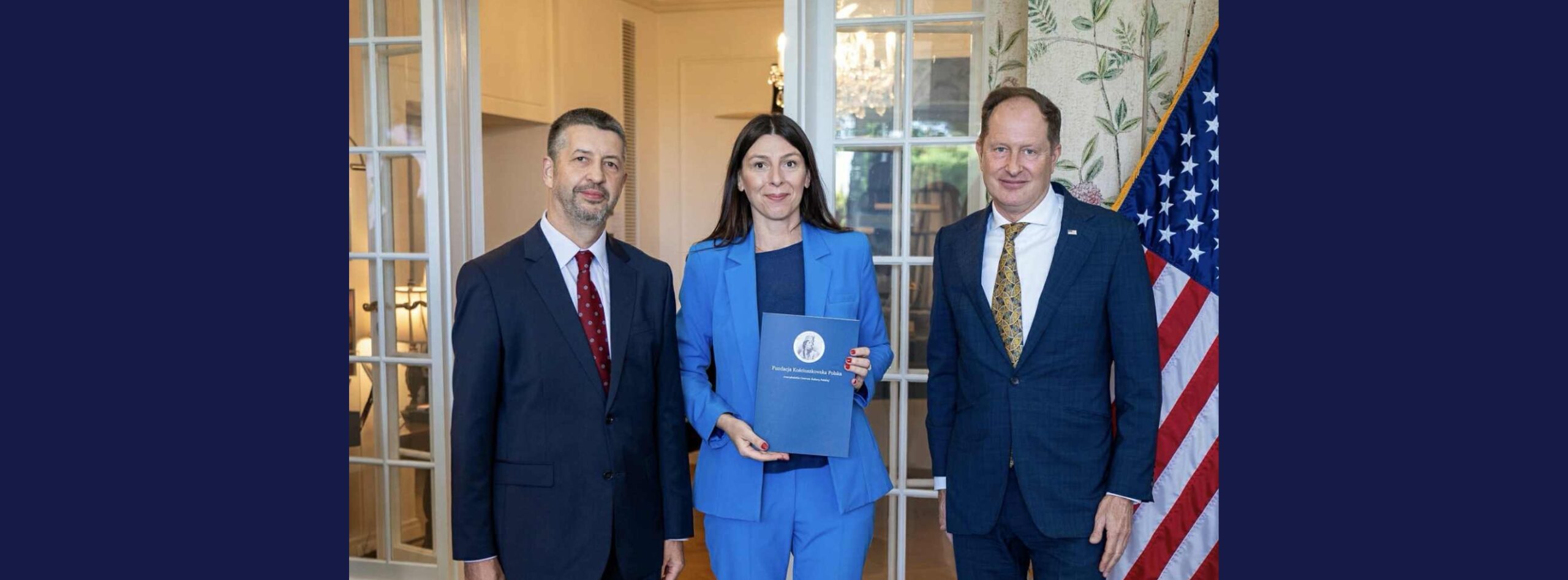
“In academic terms, the Kosciuszko Foundation fellowships are a very rare opportunity to meet world-class experts, visit leading universities, focus on your research, have access to new sources (e.g., National Archives) or state of the art labs.”
– Dr. Katarzyna Maniszewska, 2024/25 Exchange to the U.S. fellowship recipient
I was fortunate to receive a Kosciuszko Foundation Research Fellowship. In August 2024, I ventured to the US to pursue my research. For over 3 months, I was researching, learning, and… networking, because the invaluable aspect of the Kościuszko scholarships is people-to-people relations, which build bridges in academia and beyond. As the Foundation celebrates its 100th anniversary, it is worth emphasizing that this is precisely what the Foundation has been doing for a century: enabling students, scholars, and artists to grow, and at the same time strengthening bonds between Poland and the United States.
I conducted my research at the Program on Extremism (PoE) at George Washington University. Founded in 2015, PoE is a leading research center on all forms of extremism. I was working on a project titled “RADICALIZATION AT HIGH SPEED: TERRORISM AND THE MEDIA IN THE AGE OF AI.” It was a continuation of my previous work, which I have been conducting since 2002. In my book “TERRORISM AND THE MEDIA,” published in Poland in 2006, I used the case study of the German leftist organization Red Army Faction (RAF). I examined the media coverage of terrorism during the active years of the RAF and the post-9/11 coverage of terrorism. The mass media analyzed at that time were primarily television and print media. Much has changed since the first decade of the 2000s. In 2005, only about 16% of the world’s population, or approximately 1 billion people, had access to the internet. As of 2023, that number has grown to 5.4 billion people or 67% of the world’s population. (Still, 2.6 billion people remain digitally excluded, so the limitation of the research was that many findings only apply to digitally included individuals, particularly the target groups of terrorist and extremist actors). During my fellowship, I took a closer look at the modus operandi and its shifts alongside technological progress harnessed by terrorists.
The terrorist organizations may be among the greatest beneficiaries of the digital revolution. They harnessed the potential for propaganda, recruitment, fundraising, and training. In the era of social media and due to the widespread availability of technical equipment enabling the recording and transmission of messages and creating content by (the means of) Artificial Intelligence, anyone can become a quasi-professional content creator, and so are the terrorists and their sympathizers.
In the 21st century political extremists have not only the favor of some traditional media outlets, but they also operate own websites, online magazines, social media channels and groups, thanks to which they can design the communication process and influence it to a much greater extent. Thus, they gained a powerful instrument, increasing their impact on public opinion. We need to remember, however, that technologies are just a tool. They can be used by terrorists, but they can also be used by civil society organizations and central and local authorities to help prevent and counter-terrorism. To effectively counter terrorism, we need an informed and educated society that won’t be as susceptible to radicalization and the psychological effects of terrorism as we currently observe. I believe what’s important is that the findings are relevant to violent extremism and terrorism, regardless of ideology – whether it’s left-wing, right-wing, jihadist, or any other type – since there are common patterns that can be observed.
The results of my research were published by Collegium Civitas Press in January 2025 and are available online under a Creative Commons license. I am proud that one of the best experts on terrorism, Prof. Bruce Hoffman agreed to read my report and wrote a blurb for the cover: “Dr. Maniszewska deftly navigates today’s online universe where social media influences have more clout than scholars and journalists and where generating empathy and sympathy, not fear, has become terrorism’s 21st-century communications modus operandi. An immensely timely and valuable contribution to understanding the evolving dynamics of contemporary terrorist communications, this report is required reading for all those tracking the trajectory of terrorism at the dawn of the age of AI.”
For me, the fellowship was a turning point that opened doors: to new research (and a new book contract), to new collaborations, and to new professional opportunities. I was in DC in a very special time – just before the presidential elections and could witness the campaign and the tensions, the societal problems, the growing polarization (unfortunately very much aligned with the topic of my research…). For a scholar in international relations and security studies, it was a once-in-a-lifetime opportunity to be that close to such pivotal events radiating the whole world’s security landscape. Undoubtedly, it contributed to shaping my proposal for the Fulbright-NATO Security Studies Award, which I received in 2025. I am also honored to have been recently elected the president of the Alumni Association of the Kosciuszko Foundation.
In academic terms, the Kosciuszko Foundation fellowships are a very rare opportunity to meet world-class experts, visit leading universities, focus on your research, have access to new sources (e.g., National Archives) or state of the art labs. However, the fellowship is much more than just research, teaching or learning. It is about visiting the National Mall and the African-American Museum, venturing through New York’s Chelsea galleries guided by Józefina Chętko, an incredibly talented young Polish sculptor and a fellow Kosciuszko Foundation alumna. It is about eating a hot dog in Central Park, listening to some fine music in Blues Alley, one of the oldest jazz clubs in the US. It is about venturing to the Pacific Northwest for a long weekend and drinking some of America’s most loved coffee while listening to great rock music in Seattle. It’s about marveling at art collections in Smithsonian museums, and at street art along the U Street in DC. It’s about meeting people, exchanging views, gaining new perspectives, and experiencing the country.
I can also see how vital our alumni network is. Among the scholarship holders are people representing many academic and cultural institutions and diverse fields. People who are open-minded, interested in the world, who share the values represented by Tadeusz Kościuszko, the patron of the Foundation and who want to make their contribution to strengthening bonds between Poland and the US. I encourage and cordially invite all of the alumni to join our association!
I genuinely believe that the added value of the fellowship is equally important to the research we pursue. The Kosciuszko Foundation scholarships are, in fact, part of public diplomacy efforts aimed at enhancing collaboration between Poland and the US – in academia and beyond.
What's New?


