Celebrating Tadeusz Kosciuszko and 250 Years of Polish-American Friendship
How Tadeusz Kosciuszko Shaped Polish American Friendship
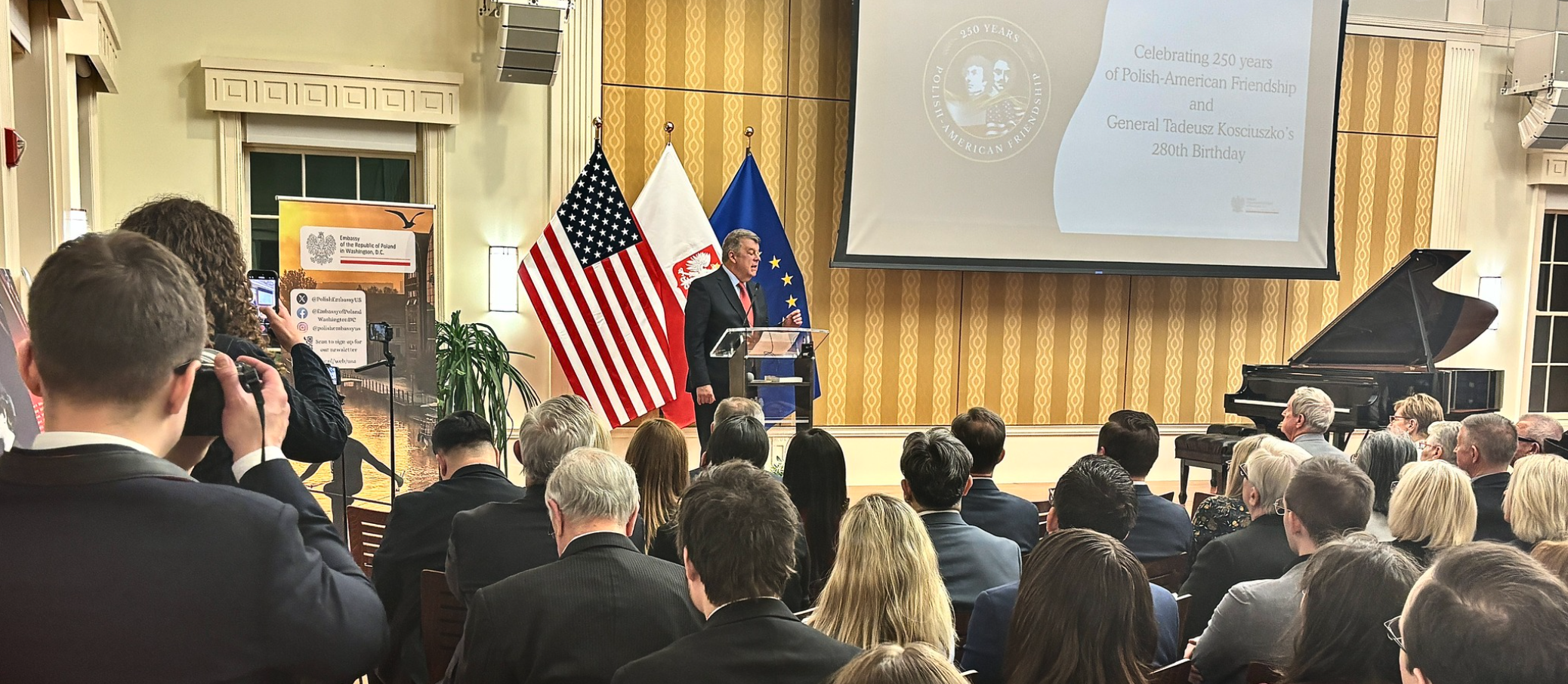
The Kosciuszko Foundation was honored to participate in a special event hosted by the Embassy of the Republic of Poland celebrating 250 years of Tadeusz Kosciuszko Polish American friendship and the 280th birthday of Tadeusz Kosciuszko.
The evening brought together distinguished Polish and American leaders, including Deputy Prime Minister of Poland Radosław Sikorski, U.S. Representative Joe Wilson, Under Secretary of State for Political Affairs Allison Hooker, and Under Secretary of Commerce for Industry and Security Jeffrey I. Kessler, alongside diplomats and members of the Polish American community.
During the program, Alex Storozynski, Chairman of the Board of Trustees of the Kosciuszko Foundation, delivered remarks reflecting on Kosciuszko’s universal message of freedom and equality.
“We stand for ‘your freedom and ours.’ That was the theme Kosciuszko conveyed to Ukrainian peasants and Russian Orthodox clergy. It was the same message he delivered in Catholic and Protestant churches. At the Old Synagogue in Krakow, he spoke with the Rabbi, who said Kosciuszko supported happiness for all, including the Jews. Jews called Kosciuszko ‘a messenger from God.’ Polish revolutionaries turned around Kosciuszko’s phrase and turned it into Poland’s motto: ‘For our freedom, and yours.”
“Kosciuszko was a product of the Age of Enlightenment, which saw the rise of reason, empirical evidence, scientific method, liberty, religious tolerance, and progress. He studied the ideals of freedom and democracy and dedicated his life to making them a reality. Kosciuszko enlisted in the Continental Army and devised the plan that won the Battle of Saratoga, the turning point of the American Revolution. He built West Point and suggested it be turned into a military academy.”
He also underscored Kosciuszko’s role in Poland’s constitutional history and the diversity of those who fought under his command:
“After the American Constitution, Poland adopted the world’s second democratic constitution on May 3, 1791. To defend that Constitution, the Poles made Kosciuszko Commander-in-Chief of the Nation. His army included regular soldiers, noblemen, peasants, and a Jewish cavalry.”
Reflecting on the cost of defending freedom, Storozynski noted the opposition Kosciuszko faced from imperial powers:
“Freedom was opposed by Czarina Catherine the Great. She sent the Russian Army to stop the democratic ideals Poland was trying to bring to Europe. Kosciuszko was thrown in prison. Anyone who has lived in Eastern Europe or Central Asia over the past five centuries lived in an era where people were oppressed by the Kremlin’s imperialism.”
He further highlighted Kosciuszko’s place among Europe’s leading liberal thinkers:
“Eventually, Kosciuszko was released from prison and given French citizenship. Kosciuszko was one of his era’s most noted liberals. The word ‘Liberal’ comes from the Latin word Liber, which means ‘Liberty, Freedom.’ A government that is illiberal is, well, the opposite of Liberty.”
Storozynski concluded by situating Kosciuszko’s ideals within the broader context of the French Revolution—and their relevance today:
“During the French Revolution, Kosciuszko was made an honorary citizen of France. The French rallying cry was liberté, égalité, fraternité. Liberty, Equality, Brotherhood. In the French National Assembly, those who supported these ideals sat to the left. Those who supported the King sat on the right.”
Storozynski concluded with a reminder of the relevance of Kosciuszko’s ideals today
“Where you stand depends on where you sit. If he were alive today, Kosciuszko would stand on the side of liberty for all.”
The program culminated with a piano performance by Martin Labazevitch and Jason Solounias.
Learn more about our mission and history here.