Witkacy: Madness, Art, and Adventure. A Talk and Film Screening at the KF Washington DC Center

The Kosciuszko Foundation
Washington DC Center
2025 O Street NW
Washington, DC 20036
The Kosciuszko Foundation Washington DC Center welcomed guests to
Hop! Szklankę Piwa! (Hop a Glass of Beer!)
Witkacy: Madness, Art, and Adventure. A Talk and Film Screening
On June 1st. 2025 at 5:00 PM at the KFDC
KF Members: $10/Non-members: $15
Please RSVP HERE
Highlights from the Witkacy Art and Adventure Event
Celebrated as one of the most enigmatic and compelling figures of the European avant-garde, Polish artist and writer Stanisław Ignacy Witkiewicz—better known as Witkacy—continues to provoke thought and inspire curiosity today.
This Witkacy Art and Adventure Event explored Witkacy’s lasting relevance in the 21st century. Guests enjoyed a conversation between Mark Rudnicki and Gertrude Gibbons, who discussed who Witkacy was, what he means for contemporary audiences, and how his legacy travels across disciplines and continents. Together, they examined his radical artistic experiments, philosophical provocations, drug-fueled explorations, and his visionary pursuit of “total art.”
The evening also featured a special screening of WITKACY & MALINOWSKI: A Cinematic Séance in 23 Scenes (Witkacy i Malinowski: seans filmowy w 23 scenach), a film by acclaimed Australian artist and filmmaker John Gillies. The film revisited Witkacy’s 1914 journey through the Australian countryside with anthropologist Bronisław Malinowski, interwoven with evocative interpretations from one of Witkacy’s plays.
Stanisław Ignacy Witkiewicz (1885–1939)
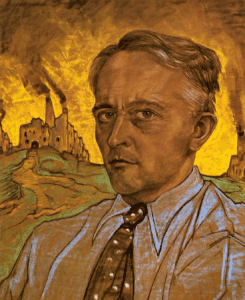 widely known as Witkacy, was a Polish writer, painter, philosopher, and playwright. A leading figure of early 20th-century avant-garde, he was known for his eccentric personality and experimental work that often blurred the lines between genres and disciplines.
Born into a prominent artistic family in Warsaw, Witkacy was deeply influenced by his father, painter and art critic Stanisław Witkiewicz. He traveled extensively in his youth, including a journey to Australia and participation in a Russian scientific expedition to Central Asia. He also served in the Russian army during World War I, which had a profound effect on his worldview and artistic output.
Witkacy’s plays and novels—such as Insatiability (Nienasycenie) and The Madman and the Nun—are known for their surreal, absurdist tone and critique of modern civilization. He was also a prolific portrait artist, running a “Portrait Firm” with a detailed list of stylistic options for clients. As a philosopher, he developed theories of art and metaphysics, especially around the idea of the “pure form.”
He died by suicide in 1939 following the Soviet invasion of Poland, symbolizing the collapse of the world he both criticized and tried to make sense of through his art.
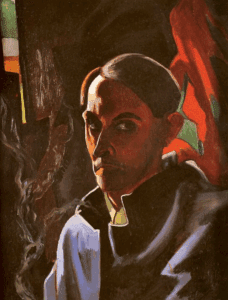
Our speakers:
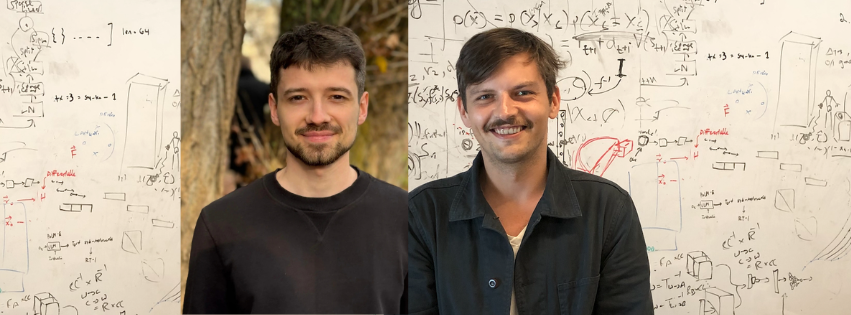
Mark Rudnicki
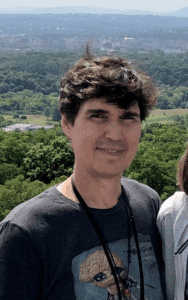
Mark Rudnicki teaches courses in advanced composition, research methods, philosophy and literature, and immigrant literature at George Mason University. He has previously taught at the University of Warsaw, Jagiellonian University, and George Washington University. A two-time recipient of the Kosciuszko Foundation Research Fellowship, he frequently speaks at international conferences, with a particular focus on the intersections of philosophy and literature in the works of interwar Polish writer Witkacy.
Gertrude Gibbons
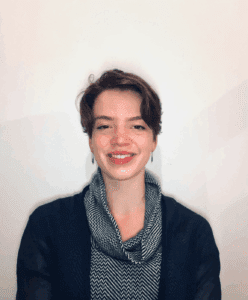
Gertrude Gibbons is a London-based writer and PhD candidate at the University of York, funded by the AHRC through the White Rose College of the Arts & Humanities. Her research traces a history of theatre-making focused on the search for a universal theatrical language. In 2024, she was awarded the Anna Micińska Award for the best debut paper at the quinquennial Witkacy conference in Słupsk. She writes across literature, art, design, and music, and has been co-editing the online arts magazine Soanyway since 2018.
Take a listen to the poem by Witkacy performed by Marek Grechuta in his song: “Hop Szklankę Piwa” .
Na skale czarnej,
spadającej w morze
stoi mój zamek,
oplata go galeria w koronki z białego marmuru..
W koronki z białego marmuru?
W koronki z białego marmuru?
Tak!
Chciałem coś pisać
co? co? co? co?
co dźwięczy jak daleki gong
gong, gong, gong, gong
co dźwięczy jak daleki gong świątyni
Kiedy? kiedy? kiedy?
kiedy, kiedy wieczorne niebo migdałowe
sklepi swą kopułę nad miastem.
Nad zrębem planety,
pośród gwiezdnej nocy,
szereg alefów w nieskończoność pełznie.
I nieskończoność unieskończoniona
zamiera sama w sobie, przez siebie zdradzona.
Kłęby, kłęby, kłęby tytanów
i rogate, i rogate widma
sypią, sypią, sypią gwiazd roje w wydarte otchłanie.
Myśl w własne wątpia zapuściła szpony
i gryzie siebie sama w swej własnej otchłani
Lecz myśl ta czyja? Samo się nie myśli
Tak jak grzmi samo i samo się błyska.
Punkt się rozprężył w n wymiarów przestrzeń
I przestrzeń klapła
Jak przekłuty balon.
Hop, hop, hop szklankę piwa
hop, hop, hop szklankę piwa
hop, hop, hop szklankę piwa
hop szklankę piwa, hop !
Dnem mojej duszy jest pierwotna mściwość
a moim herbem jest soczysta larwa
zdębiałych koni lawiny, lawiny
i oficerów zasmucone miny
Hop, hop, hop szklankę piwa
hop, hop, hop szklankę piwa
hop, hop, hop szklankę piwa
hop szklankę piwa, hop !
Ważę ciężary o jakich nie myślał żaden cezar świata
a wszystko ulata, ulata jak wata, ulata jak wata
hop szklankę piwa, hop
Nad zrębem planety,
pośród gwiezdnej nocy,
szereg alefów w nieskończoność pełznie.
I nieskończoność unieskończoniona
zamiera sama w sobie, przez siebie zdradzona.
Kłęby, kłęby, kłęby tytanów
i rogate, i rogate widma
sypią, sypią gwiazd roje w wydarte otchłanie.
Myśl w własne wątpia zapuściła szpony
i gryzie siebie sama w swej własnej otchłani.
Hop! A Glass of Beer!
On a black cliff falling into the sea
Stands my castle—wrapped in lace,
A gallery spun from white marble threads,
Lacework carved of white marble?
Yes—lace of white marble!
I wanted to write… but what?
What? What? What?
Something that rings like a distant gong—
Gong, gong, gong…
Something that rings like a distant gong
of a temple… when?
When? When? When?
When the almond dusk
Domes the sky above the city.
Above the planet’s spine,
Amid the starry night
A line of Alephs crawls into infinity,
And infinity—un-infinited—
Dies within itself,
Betrayed by its being.
Coils, coils, coils of Titans,
And horned, and horned specters—
Pour, pour, pour star-swarms
Into the torn abyss.
A thought—
Has dug its claws into its flesh,
Gnawing itself within its abyss—
But whose thought is this?
Thoughts do not think themselves—
Just as thunder does not thunder itself,
Nor does lightning flash itself
The point expanded into an n-dimensional space
And the space deflated
Like a pierced balloon.
Hop, hop, hop! A glass of beer—
Hop, hop, hop! A glass of beer—
Hop, hop, hop! A glass of beer—
Hop! A glass of beer—hop!
The base of my soul is primal vengeance,
My coat of arms—a juicy larva,
Avalanches of dazed horses
And the mournful looks of officers.
I bear weights no Caesar dared dream of
And still—it all floats away,
Away like fluff,
Away like fluff…
Hop, hop, hop! A glass of beer—
Hop, hop, hop! A glass of beer—
Hop, hop, hop! A glass of beer—
Hop! A glass of beer—hop!
Hop! A glass of beer—hop!
Above the planet’s spine,
Amid the night of stars,
A line of Alephs crawls to infinity,
And infinity—un-infinited—
Holds itself within itself,
Betrayed by its being.
Coils, coils, coils of Titans,
And horned, and horned specters—
Pour star-swarms
Into the torn abyss…
Has dug its claws into its flesh,
Gnawing itself within its abyss…
For more cultural programs, visit the Kosciuszko Foundation Events page.