From Scholarship to Solo Exhibition — An Interview with Artist and KF Alumna Marianna Stuhr
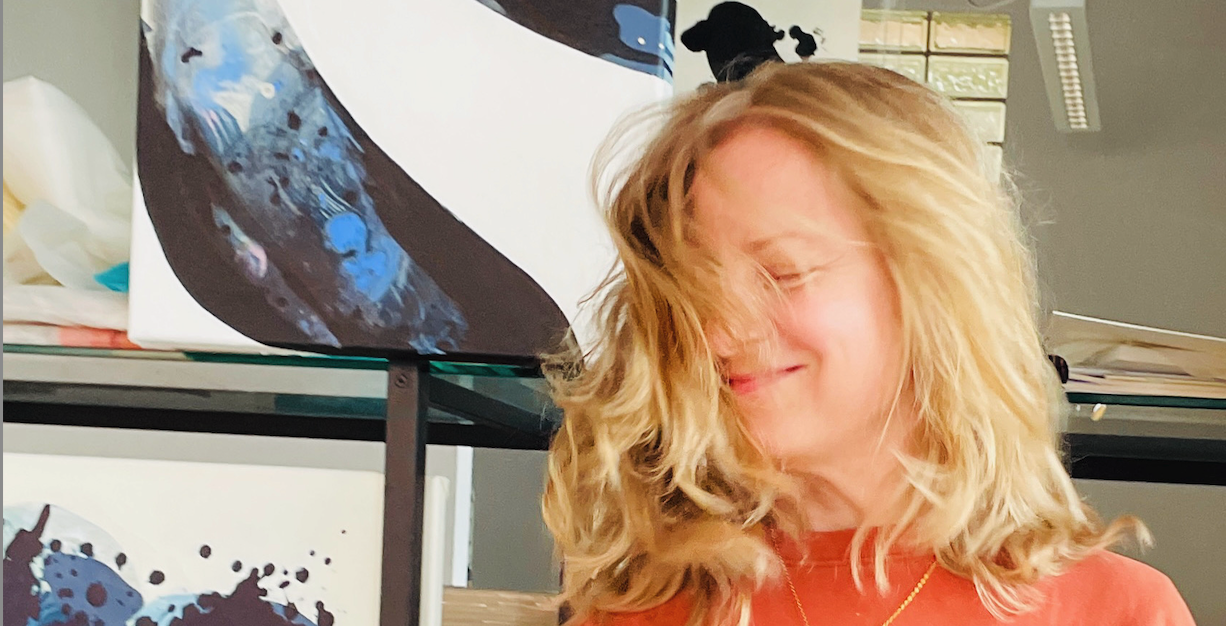
"This is why the Kosciuszko Foundation is so meaningful. It gave me—and still gives other young Polish artists—a way to begin building connections in the U.S. That's priceless."
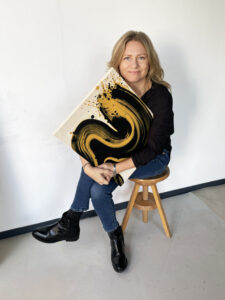
A conversation with Marianna Stuhr — painter, printmaker, and former Kosciuszko Foundation scholar. She is the daughter of the late Jerzy Stuhr, legendary Polish actor and director, and the sister of acclaimed actor Maciej Stuhr. Recognized as one of Poland’s most promising contemporary artists, Marianna is preparing an exclusive exhibition titled “STANDBY” for the Kosciuszko Foundation. The exhibition will open at the Foundation’s New York headquarters in fall 2026, followed by a presentation in Washington, D.C. She currently works and lives in Germany with her husband and children.
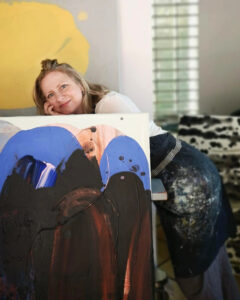
ANNA TARNAWSKA: Marianna, in 2009, you received the Kosciuszko Foundation’s Exchange to the U.S. Scholarship, which brought you to the Printmaking Department. How do you look back on that experience?
MARIANNA STUHR: It was a very important moment in my life. I was in the middle of my PhD studies, not a regular student anymore, but I still needed that intellectual stimulation you get while studying. And at that time, I was also taking my first independent steps into the world of art. The scholarship gave me the opportunity to grow—both as an artist and as an individual. It allowed me to step into an unknown environment and see how I would perform not just as an artist, but also as a performer and lecturer in a foreign language. It helped build my independence, confidence, and experience. It truly was a jump into deep water.
AT: So this was more than just a scholarship—it was a turning point?
MS: Yes—and I think every young person should have an experience like that. You learn so much about yourself, and about working in new and unfamiliar environments.
AT: How did your scholarship experience unfold?
MS: I was invited to work on an artistic project by Professor Gus Mazzocca from the Printmaking Department. I had unlimited access to all of the printmaking studios at UConn. I also brought a lot of work with me, which we exhibited at the university, but more importantly, I finally had the chance to fully immerse myself in creating art. I lived right on campus, basically next door to the studio. I had the keys. I was often the first one there in the morning and the last to leave at night.
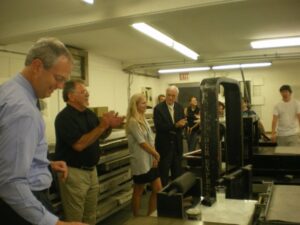
During the scholarship, I also gave lectures to students from various academic years—probably across both undergraduate and graduate levels. And the experience didn’t stop there. One of Professor Mazzocca’s former students, Framingham State University Professor Marc Cote, invited me to give a lecture to his students as well.
It was a time of enjoying an uninterrupted artistic freedom. A year later, I got married, had my first child, then my second, and life naturally changed. Since then, I have had to learn to share my time between my art and my family.
It has been challenging sometimes, but I’ve learnt to navigate through this process.
AT: How did you perceive the exchange of ideas and artistic approaches during your scholarship stay?
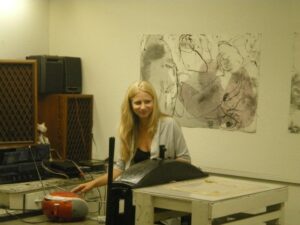
MS: I learned screen printing at the serigraphy classes at the Academy of Fine Arts in Poland. Students were particularly surprised by how broad my knowledge of printmaking techniques was. They appreciated that I could bring the knowledge about different print making styles and methods to the conversation. But the materials we used in Poland were quite harmful. In the U.S., students were already using eco-conscious paints, and there were strict rules around that. It was eye-opening and very inspiring.
AT: Did screen printing become a part of your practice afterward?
MS: Absolutely. It stayed with me for years and became one of my main techniques. I even shared the knowledge I gained in the U.S. with my colleagues back in Poland. I helped them adopt some of the safer, more sustainable methods I had learned.
AT: You currently work primarily with painting. How do painting and printmaking differ for you as artistic techniques?
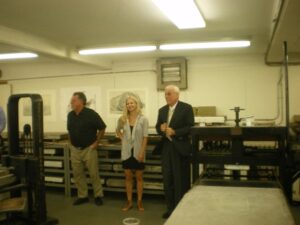
MS: Printmaking is slower and more unpredictable. So many variables affect the outcome — the acid, the plate, the humidity. You learn to manage those surprises. Painting, on the other hand, is immediate. You have your brush, your paint, your canvas — you act, and something appears right away. It gives you more control. I grew into painting slowly. At first, it intimidated me — the blank canvas felt overwhelming. But over time, I found materials I loved working with. Then one day it just clicked. I picked up a big brush, stretched a canvas, and started painting. It felt natural — like it had been waiting for me.
AT: Do you feel that learning different techniques helps you grow as an artist?
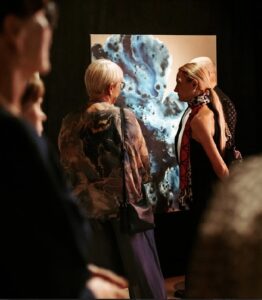
MS: Absolutely. Once you know what you want to say, having a range of techniques is like having a whole alphabet to express it. Picasso didn’t limit himself — painting, printmaking, ceramics — he used whatever served his vision. I think every artist should have the courage to explore like that. It keeps your language alive and evolving.
AT: After your stay in Connecticut, what other experiences have significantly influenced your development as an artist?
MS: Life is the most significant source of inspiration. Every experience shapes me—not just as an artist, but as a person. And I’ve always believed in preparing myself thoroughly before starting a new body of work. Even though I’m an abstract artist, my concepts are rooted in real experiences and real-life themes.
AT: So, do you approach your art both intuitively and intellectually?
MS: Exactly. During my studies at the Academy of Fine Arts in Kraków, I learned the importance of theoretical preparation. It taught me how to speak about my work— how to explain what stands behind it, and how to think deeply about the themes I explore.
AT: Could you give an example of that in your recent work — specifically the “FOR THE RECORD” series, which was exhibited last summer at the Museum of Krakow (Museum Historyczne Miasta Krakowa)? The project was dedicated to the memory of your late father, actor and educator Jerzy Stuhr.
MS: My latest body of work was inspired by a very personal experience—my father’s illness and passing. His mental deterioration and memory loss were especially hard to witness. What fascinated me was how he couldn’t remember simple, everyday tasks, yet could still go on stage and perform flawlessly. I found the selectivity with which his memory impairments occurred to be fascinating. Was it possible to adopt a way of thinking that would allow us—his loved ones—to understand the increasingly strange logic of his reasoning? While certain areas of memory remained untouched, others retained only the faintest trace, shrouded in overwhelming confusion…
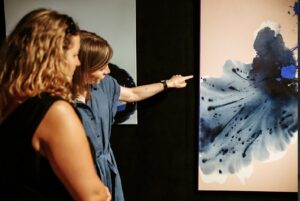
Learning about neurological concepts and visualizing the biological processes taking place in the most hidden corners of our minds helped me find peace and a sense of perspective in the face of the challenges life presented. Delving into the mechanisms of memory, observing tiny, fragile nerve cells vibrating on a microscope slide in a rhythmic entanglement of neural networks, struggling to form even the smallest of connections, reveals the extraordinary mystery and beauty of nature at its most molecular level. It is here that truth is encoded—a term perhaps most vital in all arts. I focus on reaching this truth through the creative process, striving to maintain complete authenticity — a quality that, for my father, was a fundamental criterion of artistic value, regardless of the field.
AT: How did growing up in such an artistic family influence your path as an artist?
MS: I didn’t grow up with visual artists in my immediate family, but I was surrounded by great artists—friends of my parents and their community. Artists, regardless of their genre, have a distinct way of seeing and shaping reality, and I was immersed in this perspective from an early age.
Growing up in the 1980s, during communism in Poland, I remember that everything my family and their friends did professionally had a kind of resistance in it—always “against” something. Their work was always about creating a beautiful version of the reality we lived in. That shaped me profoundly.
AT: What was your relationship with your father like?
MS: My father was accustomed to the spotlight and often struggled to transition back into regular family life. There were tensions—he expected to be the center of attention even at home. But over time, I realized that I could also shape our relationship. As I became an adult, I started seeing things differently. I understood, for example, that he was an only child, as were both his parents. He grew up with all the attention on him and didn’t have the tools to share that space within a bigger family. Realizing that helped me to be more compassionate and proactive in improving our communication.
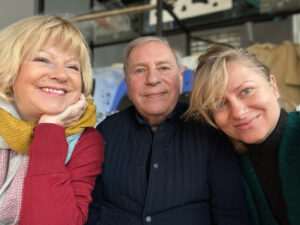
When he became a grandfather, I saw a different side of him. He truly wanted to connect with my children, though he didn’t always know how. In Polish, we’d say he did it “niezgrabnie”—awkwardly—but with love. My kids weren’t bothered by the things that had frustrated me. They just saw him as funny and endearing, and that helped me see him in a new light, too.
AT: How did you grow into this perspective?
MS: As many teenagers do, I had a rebellious streak in me. I think that’s a natural for many of us—rebelling after experiencing emotional distance or unmet needs. But as I matured, I began to see things from a wider perspective. I realized I could take responsibility—not for my father’s behavior, but for how I chose to engage with him. He was still very self-centered, but I learned how to say, “Yes, let’s talk about your project—but let’s also talk about me or my children. Let’s spend time together as a family.” And he made an effort. He really did.
AT: Was there any pressure from your family for you or your brother to become artists?
MS: There was pressure to study. That was non-negotiable. My father had this intense approach to education—he’d come home after being away for a month and start quizzing me about history or Polish literature. The questions were at times on an academic level, which I didn’t realize until I compared myself to other kids and thought, “Wait, this isn’t normal!” But I understood that in our family, education was seen as the gateway to a better life. It wasn’t about becoming a specific type of artist—it was about becoming educated, becoming someone who could think critically and participate in culture. That was very important to both of my parents.
AT: How do you view the differences in educational and professional opportunities between Europe and the U.S.?
MS: European countries are now very connected. Students often start their studies in one country, then continue or finish elsewhere. Transition between Europe and the U.S. is not always as easy. But for artists, no matter where you are, the most critical thing is to start building your network early. It supports and sustains your career over time. This is why the Kosciuszko Foundation is so meaningful. It gave me— and still gives other young Polish artists—a way to begin building connections in the U.S. That’s priceless.
AT: In the fall of 2026, you will present a solo exhibition at the Kosciuszko Foundation in New York. Once a scholarship recipient, you’re now returning to KF as an accomplished artist. Can you tell us about the concept behind your upcoming show?
MS: I’m developing a new series of paintings specifically for this exhibition. It’s still evolving, but the working title is “STANDBY.” The project explores the psychological state of suspension—of being caught in a reality beyond our control. This stems from my own experience of having to rearrange life repeatedly due to external forces like COVID or my husband’s career. We’ve lived between cultures: Poland, the U.S., and now a third country, Germany, always adjusting to new environments that weren’t part of our original plan.
I want to capture that in my work—this in-between space where plans are disrupted, and belonging feels uncertain. Each piece will reflect this emotional state, not through action, but through stillness, tension, and anticipation. It’s an ambitious project, but one I feel deeply connected to. I realized that I’ve been living in this “standby mode”—where plans are paused, belonging feels uncertain, and time stretches out. And I think many people, especially immigrants and those navigating global transitions, can relate to.
AT: In what ways do you see these experiences as universal, and how are they uniquely related to Polish culture or identity?
MS: That’s something I think about a lot. Slavic people tend to be sentimental—we dream big but carry the weight of what we left behind. I often reflect on the privileges I had in Poland and the risks I took in building something from scratch elsewhere. But there’s also deep satisfaction in knowing that what I have now, I built myself. I may not know where this journey will take me, but I know I’m following something meaningful and true.
AT: Do you feel that you’ve found your place on Earth yet—or are you still in search of it?
MS: I’m definitely still searching. And that’s okay. I’m driven by something inside me that I can’t quite explain. No one in my family had the ambition to live abroad or build a multicultural life. But I’ve always wanted that. I’ve always wanted to experience the world, to start fresh, to grow beyond what I knew. Leaving Poland wasn’t easy. I gave up a lot of privilege and familiarity. But the life I’m building now feels very much mine. I don’t owe it to anyone but myself. That’s incredibly rewarding— even if it’s hard work.
Thank you for the conversation!
 Did you enjoy reading this interview? We’ve curated more stories like that in our 2025 KF Newsletter. Read HERE