Introducing Tadeusz Dąbrowski — By Joshua Weiner
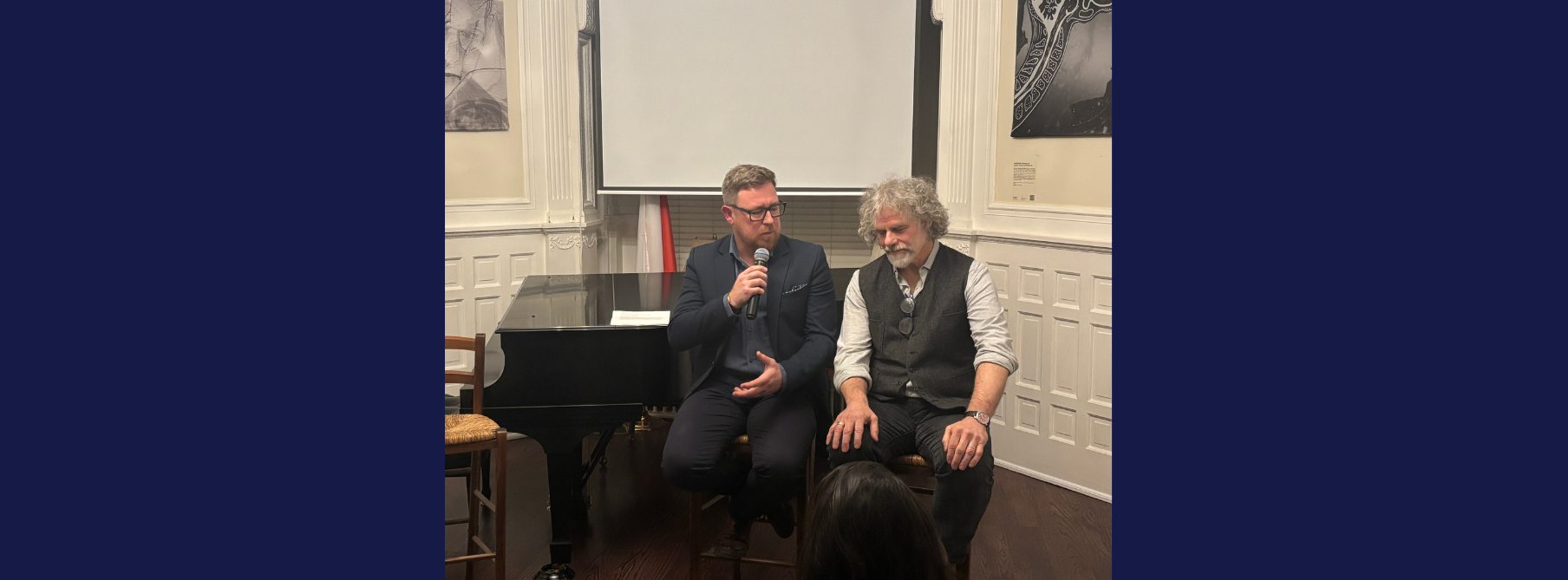
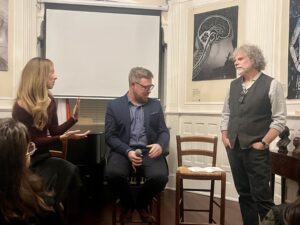
On October 25, the Kosciuszko Foundation Washington, D.C. hosted the Tadeusz Dąbrowski Poetry Reading, featuring one of Poland’s most acclaimed contemporary poets during his East Coast tour for "The Scent of Man." During the evening, Dąbrowski was introduced to the audience by Joshua Weiner — American poet, translator, and professor of literature at the University of Maryland — who offered a thoughtful reflection on his life and work, marking a memorable moment in the Tadeusz Dąbrowski Poetry Reading series of events.
Below, we share Joshua Weiner’s introduction to the poetry of Tadeusz Dąbrowski, presented during the event at the Kosciuszko Foundation in Washington, D.C.
Reflections from the Tadeusz Dąbrowski Poetry Reading — By Joshua Weiner
In Poland, the literary cities where cultural power tends to be centered are Warsaw and Kraków; if you combined them, you’d get something approaching the influence of New York City in the U.S. This region of cultural power in Poland is not where Tadeusz Dąbrowski is from. He hails from the free city of Gdańsk, on the northern coast of the Baltic Sea, where it comprises one point of the Tri-City region with Gdynia and the resort town of Sopot, the place of the poet’s childhood. (The analogy here in the U.S. might be something like having an international reputation in literature while continuing to reside in your childhood city of Portland, Maine).
Gdańsk is the famed seaport area of the Hanseatic League, the medieval trading union, and also where Lech Wałąsa led the Solidarity movement in opposition to the Soviet Union and the eventual collapse of Communist totalitarianism in Eastern Europe — a legacy often evoked during the Tadeusz Dąbrowski Poetry Reading to contextualize his independent spirit.
Although, in 1981, Tadeusz was only a toddler at that time, this proud history is not insignificant. There is something in the water, one could say, up there in Gdańsk, something in the character of the people; a kind of independent spirit that, in its expressiveness, is direct, ironic, subtle, forceful, nimble. They know how to dance with hammers in their hands; and their iconoclasm shows up in Dąbrowski’s poems as a kind of tense skepticism: skeptical, because it doesn’t take anything at face value—it probes and jokes, and wonders about the nature of reality and super-reality; tense, because it still believes in something beyond our quotidian and terrestrial understanding.
One important quality or aspect of Dąbrowski’s poetry that we can experience in English, in fact, is this kind of tension, which depends, in terms of poetic form, on the absolute fidelity to the timing of the verse, how things show up and land in the poems; and we have the translator Antonia Lloyd-Jones to thank for this.
Dąbrowski is essentially a kind of metaphysical poet. I don’t want to say too much about the poems. But pay attention to how ordinary experiences in the poems reveal something unexpected on the underside of existence, how they point to a plane of reality that is a part of our life, but that we tend not to notice. How the poem, therefore, is the form of an act of noticing, and becomes a first moment of dropping into self-knowledge.
Dąbrowski belongs to a generation of poets that came out from under the shadow cast by outsized elder poets such as Miłosz, Symborska, Zbigniew Herbert, and most importantly for Dąbrowski, Tadeusz Różewicz, a significant influence and supporter, as well as Adam Zagajewski. Among the other burdens Dąbrowski has had to shrug off, we might include the mind-forged manacles of a dogmatic Catholicism; the continued pernicious reach of the State into the psyche of the individual; the contemporary moment’s fashionable literary wardrobe; and the heavy backpack of historical imperatives.
Unlike other poets of his generation, however, who have paid such close attention to poets in the U.S. associated with developments in postmodernism—especially in regards to Pop, and to a kind of distrust in the capabilities of language—Dąbrowski holds to some of the ambitions of poetry to speak to our human condition, albeit with a wry wit and minimalist approach. Language escapes us, but it also returns, because we are its home; Dabrowski is at home in that understanding.
But who is this Dąbrowski, as he’s recognized and considered in the world outside of his own prevarications, dreams, visions, and wondering?
In addition to being a poet, Tadeusz Dąbrowski is an essayist and a critic, and the editor-in-chief of the literary bimonthly Topos. In the U.S., he has been published in The New Yorker, Paris Review, Boston Review, Threepenny Review, Ploughshares, American Poetry Review, Guernica, among many others. And he has won numerous awards, including residencies in the U.S. His work has been translated into 30 languages. In Polish, he is the author of nine volumes of poetry, and a novel set in New York City, and there are a dozen books in translation.
The Scent of a Man is Tadeusz Dąbrowski’s third book in English; his two earlier collections in English, also beautifully translated by Antonia Lloyd-Jones, are Black Square and POSTS, which I also highly recommend to you.
The poet has announced that he will read tonight in the dark, with the house lights down. Being in the dark—that may be a spiritual condition (!) embodied in his proximity and absence; or it may be an experiment in promoting the voice of the poet while reducing a certain kind of silent noise that is created by standing before an audience. Perhaps we may find ourselves also disappearing, into the poems by Tadeusz Dąbrowski.
Explore more Kosciuszko Foundation cultural events.
Tadeusz Dąbrowski’s poetry collection “The Scent of Man” is available from Arrowsmith Press.
Poets Tadeusz Dąbrowski (left) and Joshua Weiner (right) during the evening at the Kosciuszko Foundation

Tadeusz Dąbrowski reading his poems in the darkness.
 About Joshua Weiner:
Joshua Weiner is a poet, translator, and professor based in Washington, D.C. He is the author of four poetry collections, including “The World’s Room, From the Book of Giants,” and “The Figure of a Man Being Swallowed by a Fish” (University of Chicago Press), as well as the satirical chapbook “Everything I Do I Do Good: Trumpoems.” He also edited “At the Barriers: On the Poetry of Thom Gunn.”
His many honors include the Whiting Writers Award, the Rome Prize, a Guggenheim Fellowship, and the Amy Lowell Poetry Traveling Scholarship. His translation of Nelly Sachs’ “Flight and Metamorphosis” (with Linda B. Parshall) was published by Farrar Straus Giroux in 2022 and was shortlisted for the 2023 National Translation Award in Poetry.
Weiner teaches in the English Department at the University of Maryland, College Park, and lives in D.C. with his wife, novelist Sarah Blake, and their two sons.